Students in CTU Environmental Justice Freedom School tackle climate concerns in their schools and community
Rosario Gonzalez, a rising senior at Juarez Community Academy, has always thought she was connected to the environment. But her involvement in CTU’s Environmental Justice Freedom School this summer gave her a new perspective.
“I always thought I was connected to the environment because I love hiking and being outside in nature. But now I have a different perspective,” she said. “The program really opened my eyes—nature is something you should actually take care of.”
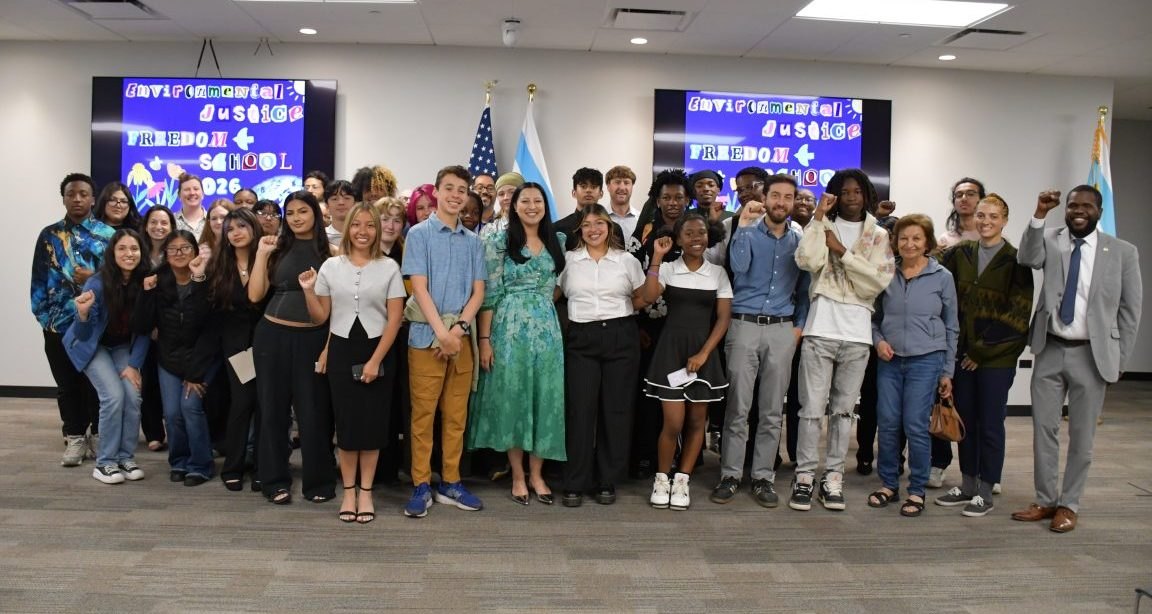
Modeled on the Freedom Schools of the civil rights movement, CTU’s two-week program helps students develop the tools and skills needed to take care of their environment by developing local school climate action plans. This year, 19 new students and five returning students, spent part of their summer vacation tackling the environmental issues plaguing their communities.
After completing the program last year, Aleidy Dominguez, another Juarez student, returned as a mentor to share what she learned. “When I first started the program, I didn’t know much about environmental justice,” she said. “But I learned about the issues impacting my community. Now, I understand what environmental justice is and believe we deserve it.”
Students and the program’s nine educators spent much of the two weeks out in the field. They met with Cheryl Johnson, the daughter of the late Hazel Johnson, widely considered the mother of the modern environmental justice movement. Cheryl inspired them to advocate for their communities and become the next generation of environmental justice leaders.
They also visited Big Marsh Park, a 300-acre nature preserve on the South East Side, and the Wild Mile, a floating island in the Chicago River. At Steelworkers Park in South Chicago, students climbed a rock wall on the grounds of an old steel mill. And at Black Oaks Center, a Black-owned farm located 60 miles south of Chicago, students toured the farm and learned about its programs to promote sustainable and resilient communities.

At the end of the program, students presented their climate action plans to a group of CPS and city leaders, including Deputy Mayor of Education Khari Matthew Humphries, Deputy Mayor of Community Safety, Emanuel Andre, and members of the Chicago Public Schools Science education team.
Students at Solario High School believe improving their school will help improve their mostly Latine, working class Gage Park community. That’s why Xitali Cruz and Julani Lopez proposed replacing the school’s pool water heaters and, at the same time, installing solar panels to reduce electric bills.
At Percy Julian High School, sophomore Alonzo Collins tackled the problem of lead in the school’s drinking fountains, which have levels far in excess of what is considered safe. “We should have access to clean drinking water just like the rest of Chicago,” he said.
Students at George Washington High School presented a plan to install solar panels, which could save the school $100,000 a year. The students want CPS to use those savings to fix the school’s crumbling infrastructure—a part of a ceiling collapsed in a hallway a few years ago.
Washington student Kyren Gonzalez connected his school’s problems to the larger issue of inequity in CPS. “Just because we’re on the South East side, doesn’t mean we don’t deserve the same quality education as other schools,” he said. “School is supposed to be a safe place, not a place that hurts students.”
During a question and answer session with CPS and city officials, Englewood STEM student Derion Melton asked CPS officials a pointed question about those inequities: how does the district prioritize facilities funding to ensure that schools most in need of repairs get them?.
Melton was unimpressed with the answer, but no worries. He feels the CTU program has given him the tools to advocate for what his school and community need. “This was an amazing experience and not just a school experience, but a life experience,” he said. “It’s gonna help me advocate on the issues I care about in my community.”
CTU President Jackson Potter encouraged students to continue advocating and engaging in the political process. “Find out who your alderperson is. And continue building support, not just in your school but in the wider community because you need a broad base of support to win these fights,” he said.
CTU Vice President Jackson Potter and Northside College Prep educator Ayesha T. Qazi-Lampert and Jason Maurice Porter, co-founded the EJF program four years ago. “We want students to leave the program feeling empowered and with agency to become environmental justice leaders in their schools and communities.” Qazi-Lampert teaches environmental science at Northside College Prep High School and is a member of the CTU’s Climate Justice Committee.
Seven other dedicated educators helped guide students through the exciting program this year. Dee Fedrick, Nabil Jaffar, Michelle Hernandez, Shondra Cooper, Maryjulie Odinga and Emma Macmillan all took two weeks out of their summer break to work with students alongside with the students to learn how to incorporate EJ principles into their classroom instruction. s.
The Children & Teachers Foundation of the CTU is proud to coordinate and fund the EJ Freedom School’s two-week summer program for Chicagoland high school students. All thanks to the partnership and support from Southeast Environmental Justice Task Force, People for Community Recovery, Friends of Big Marsh, Urban Rivers, Black Oaks Center for Sustainable Renewable Living, and the Chicago Ornithological Society.